Testing of configurable and variant rich industrial applications
Detailed Description
Focus of the industrial production use case is the efficient handling of variant rich, highly configurable industrial production applications. There are two demonstrators for this use case mainly addressing the testing of control systems but with different test infrastructure setups. In the ABB use case, a distributed control system (ABB 800xA) is the test object. In the FFT use case, a flexible production unit (called CUBE) is the test object whereby the testing of the plc program is the focus of this use case.
Demonstrator: ABB 800xA
ABB is the world leader in the production of industrial automation solutions and equipments in many sectors such as oil and gas, mining, robotics, power grids, renewable energy, and so on. With more than four decades at the forefront of digital technologies, ABB is a leader in digitally connected and enabled industrial equipment and systems with an installed base of more than 70,000 control systems connecting 70 million devices. More than 1000 industrial companies, factories, and plants worldwide use the ABB’s 800xA distributed control system. The software on this system needs to be configured and customized for different customers both before deployment and on-site. Together with the partners in XIVT, ABB seeks to solve the challenge of testing different configurations of 800xA system. Participation in XIVT enables ABB to keep its leading position in the market due to cost and time reduction through more effective and automated testing solutions and identifying bugs that can stay undetected when a product variant is instantiated and configured from a product line. This, in turn, helps and enables to deliver higher quality products (than the competitors) to the market. XIVT results have the potential to be adopted by several of our development offices across the world.
Demonstrator: FFT CUBE
FFT’s demonstrator is a flexible production unit (called CUBE) from an automotive body-shell assembly line (Figure 1). In future, such CUBEs must be designed in such a way that future products can be produced by same CUBEs. Consequently, existing complex PLC programs must be extended by additional control programs. Thereby, the challenge for a plant manufacturer is the systematic and automated testing of the extended PLC programs which becomes more and more complex. In most cases, PLC programs are developed by different employees and there is no overview of existing PLC programs when integrating a new product.
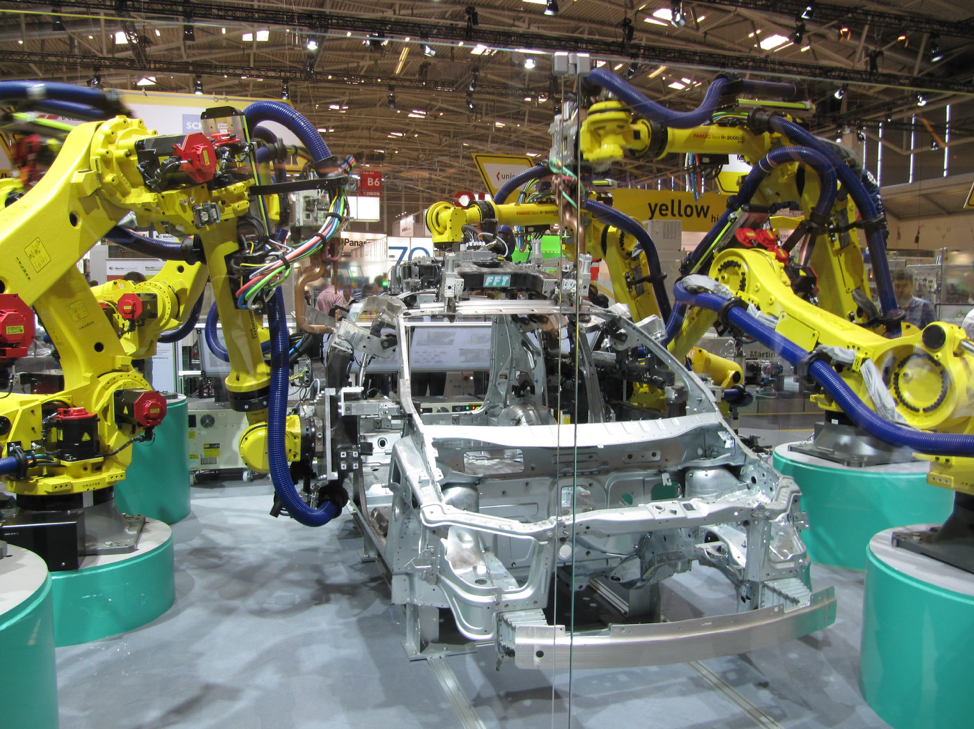
Exemplary CUBE from the automotive field
The challenge in this use case is to check all functionality of the CUBE, including safety of persons, mechanisms and products, as well as the correctness of process and time sequences after an integration of new product or rather of extension of existing PLC program as well as robot control programs. Currently, haphazard testing of functionality is performed manually by a plant manufacturer and partly confirmed. Furthermore, the developers of the existing program are not the same developer who enhances it. Rare test cases are provided by OEMs as plain text defined in free form.
During Virtual Commissioning of a CUBE, not all product variants are designed and taken into account into PLC program. In most cases, additional variants / extended PLC program are tested without Virtual Commissioning direct on the real CUBE. Regarding to this, detected trouble shootings are solvable via enormously effort and under time pressure. Additionally, damage on CUBE’s mechanic could arise if error prone systems will be deployed.